
- MEDThrive™
- Shop
- EASE Rx PLUS™
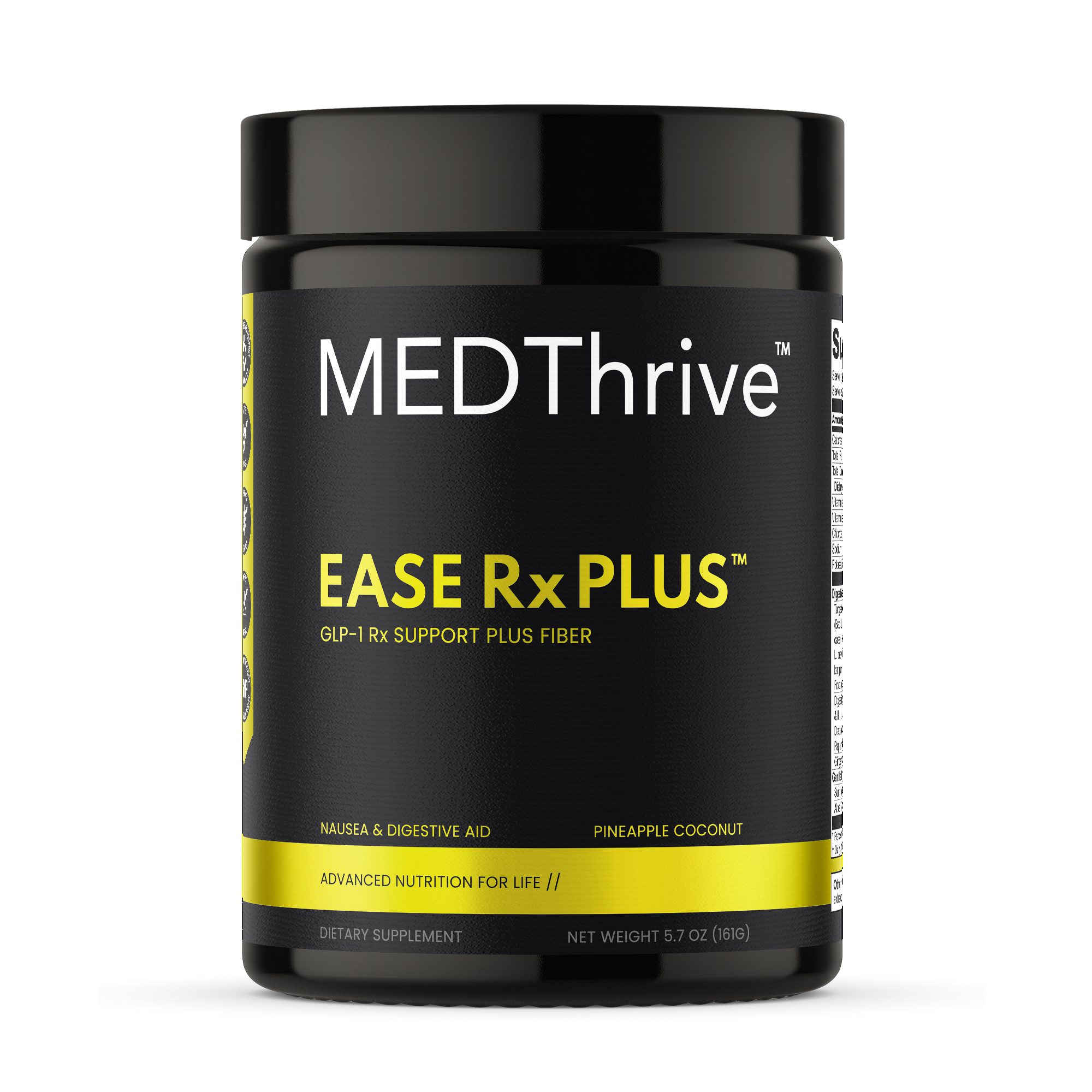

EASE Rx PLUS™
GLP-1 Rx SUPPORT PLUS FIBER
Available in: Delicious Pineapple Coconut Flavor
Benefits:- Nausea & Indigestion Relief*
- Reduce Bloating & Gas*
- Support Healthy Gut Microbiome*
- Improve Hydration*
- Gently Helps Alleviate Constipation*
FREE FROM

Wheat, Soy,
Eggs

Artificial Colors, Sweeteners & Flavors

GMO FREE

Unnecessary Binders &
Fillers

Tree Nuts, Peanuts
& Sesame

Magnesium
Stearate

Gluten Free

Trans Fat &,
Hydrogenated Oils
EASE Rx PLUS™ contains a combination of scientifically validated, potent, natural ingredients that help alleviate the uncomfortable side effects associated with GLP-1 stimulating medications. EASE Rx PLUS™ from MEDThrive is the first product ever developed to specifically address these side effects and nutrient depletions. Our innovative and unique, targeted formulas are scientifically designed to work alongside these medications to enhance patient comfort, success, and compliance.
Formulated with clinically validated ingredients to help alleviate uncomfortable side effects associated with GLP-1 stimulating medications.
Suggested Use: Take one serving as needed, or as directed by your Healthcare Professional.
Warning: If pregnant, nursing, taking medication or have a known medical condition, consult a Healthcare Professional before use.
EASE Rx PLUS™ contains a combination of scientifically validated, potent, natural ingredients that help alleviate the uncomfortable side effects associated with GLP-1 stimulating medications. EASE Rx PLUS™ from MEDThrive is the first product ever developed to specifically address these side effects and nutrient depletions. Our innovative and unique, targeted formulas are scientifically designed to work alongside these medications to enhance patient comfort, success, and compliance.
How EASE Rx PLUS™ Helps Ease Your Side Effects With Natural Nutrients
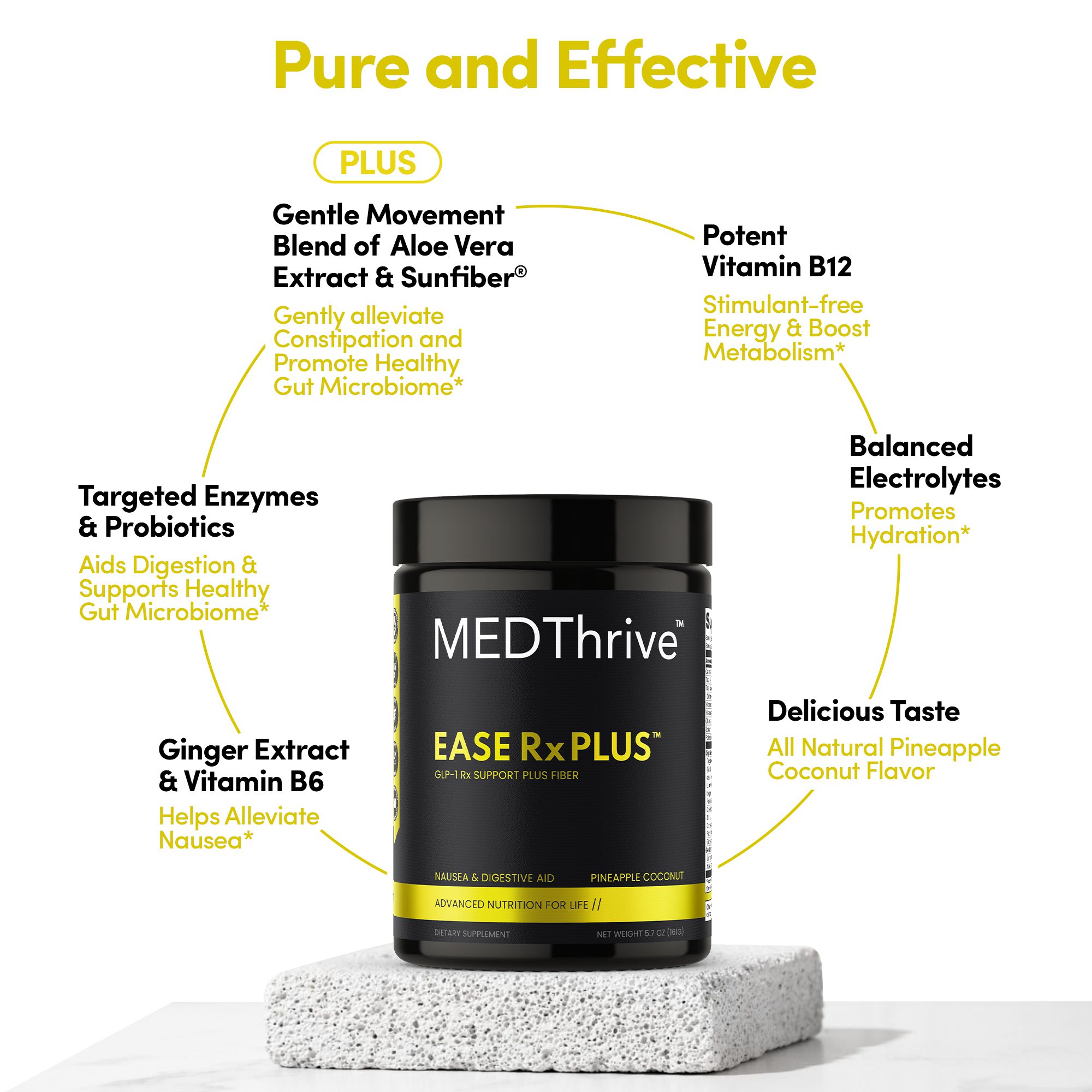
1. Ginger Extract & Vitamin B6: Help alleviate nausea & gut discomfort*
Ginger and Vitamin B6 (pyridoxine) are clinically proven to combat nausea and calm the stomach. The combination has been found to be nearly as effective against nausea as the use of other antiemetic (nausea reducing) medications.*
Ginger, the rhizome of Zingiber officinale, has a long, established history of medicinal use in humans. It has been used as a complementary medicine for gastrointestinal ailments for centuries and recent research has verified this. A 2018 study stated “Based on evidence from this systematic review, ginger could be considered a harmless and effective alternative option for women suffering from the symptoms of nausea and vomiting.” A double-blind study concluded “The nausea score and the number of vomiting episodes were significantly reduced following ginger and vitamin B6 therapy.”
2. Targeted Enzymes & Probiotics: Aid digestion, reduce bloating & support healthy gut microbiome*
EASE Rx PLUS™ contains a proprietary Digestive Ease Complex™ specifically designed to help reduce GLP-1 medication symptoms. The complex contains:
- Full Spectrum Enzyme Blend to help break down foods, for easier digestion, reducing bloating/gas and discomfort.*
- Comprehensive Probiotic Blend to support a healthy microbiome by combating bad bacteria growth in the intestines.*
Digestive enzymes and probiotics are a natural, gut-protective combination that help improve nutrient uptake as well as reduce bloating and gas. Supplementing with full-spectrum enzymes (that breakdown all types of food) helps the body digest foods easier, especially when GLP-1 medications are limiting the release of gastric acid. Research stated “Digestive enzyme preparations enhance digestive power, help in the complete absorption of nutrients, and match the body’s natural metabolism… and are well tolerated”. Further, the delayed release of food into the body and its conversion to energy can cause fatigue and lethargy. Combining the enzymes with targeted probiotics has been clinically shown to help restore a healthy gut microbiome because some patients experience a condition called SIBO (Small Intestinal Bacterial Overgrowth). This happens when the bacteria in your small intestine become overgrown. Taken preventively, probiotics may prevent SIBO from happening, minimize bloating, promote GI motility, and help sustain a healthy microbiota.*
3. Vitamin B12: Support metabolism & promote stimulant-free energy*
EASE Rx PLUS™ helps supply your body cells with vital B vitamins needed to boost natural energy levels and support metabolic function. Ease Rx is:
- Fortified with vitamins B6 and B12, essential to energy metabolism, helping convert fat and protein into usable energy.*
- All-day energizing via a 1000 mcg dose of highly bioavailable B-12. B-12 is needed to make red blood cells, which deliver energizing oxygen throughout your body.*
Vitamin B12 is essential to maintain metabolism and energy. It helps convert fat and protein into usable energy. Low levels of vitamins B6 and B12 can cause inefficiency in fat metabolism, making it difficult for the body to burn fat. Vitamin B12 is also needed to make red blood cells, which deliver energizing oxygen throughout the body all day. B vitamins also work in synergy with GLP-1 drugs because these medications help drive the uptake of these critical nutrients via insulin. Insulin acts as a shuttle, pushing vital nutrients such as B vitamins into the cellular mitochondria, which drives metabolism, and energy. In fact, research found GLP-1 agonists have better bioavailability when conjugated with Vitamin B12. This boost is achieved because GLP-1 medications stimulate the release of insulin in the body. Insulin pushes these vital nutrients into the cellular power plants called mitochondria which drives metabolism, boosting energy production.*
4. Balanced Electrolytes: Promote rapid hydration with no bloating*
EASE Rx PLUS™ helps hydrate you through a precise quantity of electrolytes. Staying hydrated helps patients feel better, less bloated and less nauseous. Sodium, potassium and chloride (electrolytes) are provided in a precise amount and ratio to maximize uptake by supporting rapid gastric emptying with no bloating. It is essential to staying hydrated while using GLP-1 medications.*
Hydration is critical from the skin to the cellular level. The body needs electrolytes to function properly. Electrolyte balance allows your cells to transfer nutrients efficiently, subsequently supporting many vital metabolic functions.
Dehydration can leave you feeling fatigued, contributing to gut discomfort, headaches, rapid heart rate and dry mouth/skin. However, more isn’t always better with electrolytes as some popular hydration drinks try to convince you of. Too many electrolytes can actually draw water to your stomach (away from the muscles & skin), bloating you and impairing gastric emptying. So it is important to get the amount and balance of electrolytes right.
Dehydration while taking GLP-1 medications may be partially attributed to the reduced fluid intake and slow gastric emptying. When gastric emptying is significantly delayed (Gastroparesis, a common side effect of GLP-1 medications), electrolyte therapy is believed by researchers to be a key intervention. A recent study stated “The therapeutic options for motility disturbances in… patients include the adjustment of electrolyte imbalances.”
PLUS
5. Gentle Movement Blend of Aloe Vera Extract & SunfiberⓇ: Gently Alleviates Constipation & Promote Healthy Gut Microbiome*
EASE Rx PLUS™ contains a “Gentle Movement Blend” of highly concentrated Aloe Vera and clinically proven prebiotic Sunfiber® which together, promote a healthy digestive balance by gently reducing constipation, soothing the gut, feeding beneficial gut bacteria, and improving regularity.
Aloe vera has been used for centuries to support digestive and gut health as well as constipation or diarrhea. Aloe vera contains enzymes that help the breakdown of sugars and fats. It also contains plant compounds called anthraquinone glycosides which have been shown to have a laxative effect and help relieve constipation. Research also shows aloe vera may decrease irritation in the stomach and intestines by soothing gastrointestinal inflammation.
Sunfiber® is a unique, prebiotic, soluble fiber that has been proven to help maintain digestive health and microflora balance without the excess gas or bloating associated with other fibers. Produced from Guar beans, its clinical benefits are backed by more than 180 published studies, including 120 human clinical trials. Research shows it aids regularity, for both occasional constipation and occasional diarrhea as well as lowers serum cholesterol, and feeds beneficial gut bacteria, promoting healthy gut flora for digestive health.*
Theodosios D. Filippatos, Thalia V. Panagiotopoulou, Moses S. Elisaf, 2015, ‘Adverse Effects of GLP-1 Receptor Agonists’, Review of Diabetic Studies, 2014, 11(3-4):202-230.
Mehrnaz Nikkhah Bodagh, Iradj Maleki, Azita Hekmatdoost, 2018, ‘ Ginger in gastrointestinal disorders: A systematic review of clinical trials.’ Food Science and Nutrition, 05 November 2018.
Megan Crichton, Alexandra R Davidson, Celia Innerarity, Wolfgang Marx, Anna Lohning, Elizabeth Isenring, Skye Marshall, June 2022, ‘Orally consumed ginger and human health: an umbrella review.’ The American Journal of Clinical Nutrition, Volume 115, Issue 6, Pages 1511–1527.
Sripramote M, Lekhyananda N, Sep 2003, ‘A randomized comparison of ginger and vitamin B6 in the treatment of nausea and vomiting of pregnancy.’ Journal of the Medical Association of Thailand, 86(9):846-853 PMID: 14649969
Sahakian V1, Rouse D, Sipes S, Rose N, Niebyl J, Jul 1991, ‘Vitamin B6 is effective therapy for nausea and vomiting of pregnancy: a randomized, double-blind placebo-controlled study.’ Obstetrics and Gynecology, 78(1):33-36. PMID: 2047064
Balkrishnan A. Therapeutic Uses of Peppermint – A Review. Journal of Pharmaceutical Sciences and Research; Cuddalore, Vol 7, Iss 7, July 2015: 474:476.
B. P. Chumpitazi, G. L. Kearns, R. J. Shulman. The physiological effects and safety of peppermint oil and its efficacy in irritable bowel syndrome and other functional disorders. Alimentary Pharmacology and Therapeutics; Vol 47, Iss 6, March 2018 738-752.
R. Kerry. J. Patra, S. Gouda, Y. Park, H. Seung Shin, G. Das, ‘Benefaction of probiotics for human health: A review’. Journal of Food and Drug Analysis, Volume 26, Issue 3, July 2018, p 927-939
Wu, Keng-Lianga; Rayner, Christopher K.b; Chuah, Seng-Keea; Changchien, Chi-Sina; Lu, Sheng-Nana; Chiu, Yi-Chuna; Chiu, King-Waha; Lee, Chuan-Moa, ‘Effects of ginger on gastric emptying and motility in healthy humans’. European Journal of Gastroenterology & Hepatology 20(5):p 436-440, May 2008.
David Y. Graham, Gyanprakash A. Ketwaroo, Mary E. Money, Antone R. Opekun, ‘Enzyme therapy for functional bowel disease-like post-prandial distress’. Journal of Digestive Diseases, 13 August 2018
Parrish, C.R., Curr, ‘Nutrition concerns for the patient with gastroparesis’. Gastroenterol Rep 9, 295–302 (2007).
William L. Hasler, MD, ‘Gas and Bloating’ .Journal of Gastroenterology and Hepatology, 2006 Sep; 2(9): 654–662. PMID: 28316536
Wei Chung Chen, Eamonn M.M. Quigley, ‘Probiotics, prebiotics & synbiotics in small intestinal bacterial overgrowth: Opening up a new therapeutic horizon!’, Indian J Med Res. 2014 Nov; 140(5): 582–584.
Quigley EMM, Quera R. Small intestinal bacterial overgrowth: roles of antibiotics, prebiotics, and probiotics. Gastroenterology. 2006;130:S78–S90.
Joseph Boachie, Antonysunil Adaikalakoteswari,Jinous Samavat, Ponnusamy Saravanan, ‘Low Vitamin B12 and Lipid Metabolism: Evidence from Pre-Clinical and Clinical Studies’. Nutrients 2020, 12(7), 1925
Dr. Susan Clardy-James, Dr. Oleg G. Chepurny, Dr. Colin A. Leech, Prof. George G. Holz, Prof. Robert P. Doyle, ‘Synthesis, Characterization and Pharmacodynamics of Vitamin-B12-Conjugated Glucagon-Like Peptide-1’, ChemMedChem, 25 March 2013
Carol Rees Parrish, RD, MS., Cynthia M. Yoshida MD, ‘Nutrition Intervention for the Patient with Gastroparesis: An Update’. Nutrition Issues in Gastroenterology, Series #30, Practical Gastroenterology, Aug 2005
Hasler WL., ‘The Physiology of Gastric Motility and Gastric Emptying’. Textbook of Gastroenterology. 3rd Ed. Philadelphia, PA: Lippincott Williams & Wilkins; 1999:198-202.
John S. Fordtran M.D. & Travis Ward Locklear M.D., ‘Ionic constituents and osmolality of gastric and small-intestinal fluids after eating’. The American Journal of Digestive Diseases, volume 11, pages 503–521 (1966)
Medications like Ozempic®, Wegovy® (Semaglutide), Trulicity® (Dulaglutide), and Mounjaro® (Tirzepatide) belong to the class of drugs called GLP-1 analogs. In the body, the hormone GLP-1 stimulates multiple biochemical reactions which regulate digestion and appetite. These medications work by mimicking the effects of natural GLP-1 produced by the body to help patients control blood sugar, lose weight and improve their health.
These GLP-1 medications provide the following mechanisms to help patients lose weight:
- Reduce appetite: GLP-1 is naturally released when you eat food, signaling the brain that you are full. Semaglutide mimics this by binding to the same receptors in the brain, making you feel full, reducing appetite and as a result you eat & drink less.
- Slow Gastric Emptying: Not only does the GLP-1 medications signal the brain that you are full but they also significantly slow down stomach emptying and can cause Gastroparesis. Studies show slow intestinal motility as well.
- Lower Blood Sugar: GLP-1 medications lower blood glucose two ways. They increase the amount of insulin produced by the pancreas and decrease the amount of glucagon produced by the liver. By driving glucose out of the blood (insulin) and not replacing it from the liver (glucagon), the drugs effectively lowers blood sugar, increasing fat utilization especially when combined with diet and exercise.
Despite the effectiveness of these medications, most patients experience uncomfortable side-effects. Including:
- Nausea
- Bloating
- Gas
- Abdominal pain
- Diarrhea
- Constipation
- Fatigue
- Dehydration
- Muscle loss
Clinical trials have reflected that GI complaints (Including Gastroparesis) are the main adverse-event related cause of GLP-1 drug discontinuation. Nausea is reported most commonly, with over 50% of patients reporting this complaint. As a result of these uncomfortable side-effects, maintaining patient compliance is critical for long term obesity treatment and ultimately the key to patient weight loss success.
GLP-1 agonists are undoubtedly weight loss success medications. However, they also come with a range of side effects. Integrating the use of these medications with carefully selected nutrients can dramatically improve patient outcomes by helping them continue on their path to their goal weight easier. In other words, protecting against or soothing these side effects can significantly boost patient compliance, patient comfort and weight loss results.
GLP-1 medications signal your brain to slow digestion and make you feel full. However, slow gastric emptying can cause nausea, bloating, gas, diarrhea/constipation and more.